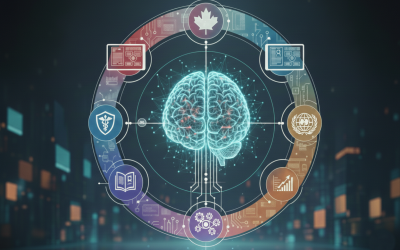
As healthcare AI systems increasingly process cross-border data, compliance is no longer about satisfying a single statute. It requires operating within overlapping regulatory frameworks that share principles but diverge in structure, scope, and enforcement.
This article examines how HIPAA (U.S.), GDPR (EU), PIPEDA (Canada – federal), and PHIPA (Ontario) intersect in healthcare AI deployments — and where alignment is possible.
Disclaimer: This article is provided for general informational purposes only and does not constitute legal, regulatory, or professional advice; organizations should consult with their legal and compliance departments to ensure adherence to specific jurisdictional requirements.
Table of Contents
- The Core Frameworks: A Global Snapshot
- HIPAA (United States)
- GDPR (European Union)
- PIPEDA (Canada – Federal)
- PHIPA (Ontario)
- The “Golden Thread”: Shared Compliance Principles
- Critical Divergences: Where One Size Does Not Fit All
- AI Implications: Training Models on Global Data
- Strategic Roadmap for Unified Compliance
- Broader Observations
- References
The Core Frameworks: A Global Snapshot
To build a compliant AI infrastructure, one must understand the specific reach of each pillar. While HIPAA governs the US, GDPR sets the global high-water mark for privacy, and Canadian laws like PIPEDA and PHIPA introduce unique provincial and federal nuances.
| Regulation | Jurisdiction | Primary Focus |
|---|---|---|
| HIPAA | USA | Protected Health Information (PHI) |
| GDPR | European Union | General Personal Data & Privacy Rights |
| PIPEDA | Canada (Federal) | Commercial Personal Information |
| PHIPA | Ontario, Canada | Health-Specific Privacy (Provincial) |
Now let’s dive into each of the regulations.
HIPAA (United States)
HIPAA regulates specific actors within the U.S. healthcare ecosystem:
- Covered Entities (healthcare providers, health plans, clearinghouses)
- Business Associates (vendors that create, receive, maintain, or transmit PHI on behalf of covered entities)
Its focus is on Protected Health Information (PHI)—individually identifiable health information maintained or transmitted in any form (electronic, paper, or oral).
Structural Components
HIPAA is composed primarily of:
- The Privacy Rule (governing uses and disclosures of PHI)
- The Security Rule (administrative, technical, and physical safeguards for electronic PHI)
- The Breach Notification Rule (notification to individuals, HHS, and in some cases media)
- Enforcement administered by the HHS Office for Civil Rights (OCR)
Observed Themes in Healthcare AI Contexts
- PHI may appear not only in structured EHR exports but in free-text prompts, clinical notes, model training datasets, tuning logs, telemetry, and error traces.
- AI vendors frequently operate as Business Associates when handling PHI, triggering contractual requirements (Business Associate Agreements) and safeguard obligations.
- HIPAA recognizes two de-identification pathways: Safe Harbor (removal of 18 identifiers) and Expert Determination (statistical risk assessment).
HIPAA is intentionally flexible and risk-based. Rather than prescribing a specific technical configuration, it requires documented risk analysis and safeguards that are “reasonable and appropriate” based on the organization’s size, complexity, and risk profile.
GDPR (European Union)
GDPR applies broadly to controllers and processors handling personal data of individuals in the European Union, including organizations located outside the EU when they target or monitor EU residents.
Unlike HIPAA, GDPR is not sector-specific. Health information is classified as “special category data”, triggering heightened protection.
Structural Characteristics
GDPR introduces:
- A required lawful basis for processing (Article 6)
- Additional restrictions for special category data (Article 9)
- Data subject rights (access, rectification, erasure, restriction, objection, portability)
- Data Protection Impact Assessments (DPIAs) for high-risk processing
- Supervisory authority oversight
- Administrative fines up to 4% of global annual turnover
In AI Systems
When AI systems process health data:
- Lawful basis analysis is foundational and must be documented.
- DPIAs are frequently required for AI systems involving large-scale sensitive data.
- Article 22 may apply where automated decision-making produces legal or similarly significant effects.
- Cross-border transfers require safeguards such as Standard Contractual Clauses and transfer impact assessments.
GDPR emphasizes accountability and demonstrability. Organizations must be able to evidence governance, risk assessments, and active safeguards—not merely maintain written policies.
PIPEDA (Canada – Federal)
PIPEDA governs private-sector commercial organizations handling personal information in provinces without substantially similar legislation, and also applies to interprovincial and international transfers.
It is principles-based and built around the Fair Information Principles:
- Accountability
- Identifying purposes
- Consent
- Limiting collection
- Limiting use, disclosure, and retention
- Safeguards
- Openness and individual access
Unlike GDPR, PIPEDA does not rely on multiple lawful bases. Instead, it centers on meaningful consent and reasonable purposes.
In AI Contexts
- Secondary uses (e.g., analytics or model training beyond initial care delivery) must align with identified purposes or require renewed consent.
- Organizations remain accountable for personal information transferred to third-party processors, including cross-border vendors.
- Breach reporting is required where there is a “real risk of significant harm.”
PIPEDA does not prohibit cross-border transfers but requires transparency and appropriate safeguards.
PHIPA (Ontario)
PHIPA governs personal health information within Ontario’s healthcare system.
It establishes:
- A defined class of Health Information Custodians (HICs)
- Rules governing agents and service providers
- Purpose-limited use and disclosure requirements
- Mandatory breach reporting in specified circumstances
For AI Developers Working with Ontario Hospitals
- The “agent” model defines accountability relationships.
- Custodians retain primary legal responsibility even when outsourcing analytics or AI processing.
- Contracts and safeguards must reflect risk, especially when services involve cloud or cross-border processing.
PHIPA does not impose explicit data localization requirements. However, custodians remain responsible for safeguarding information wherever it is processed, which makes cross-border risk assessment and contractual protections critical.
The “Golden Thread”: Shared Compliance Principles
Across HIPAA, GDPR, PIPEDA, and PHIPA, several core governance principles consistently appear.
Data Minimization
Organizations should collect and process only what is necessary for defined purposes.
In AI development, this affects:
- Feature engineering
- Training dataset scope
- Validation data selection
- Logging and telemetry retention
- Experimentation environments
Safeguards and Encryption
All four frameworks require safeguards appropriate to sensitivity.
Common industry implementations include:
- Encrypted transmission (e.g., TLS)
- Encryption at rest
- Role-based access controls
- Audit logging and monitoring
Specific algorithms are not mandated, but safeguards must be appropriate and risk-based.
Breach Notification
Notification obligations differ:
- HIPAA: Without unreasonable delay, no later than 60 days
- GDPR: 72 hours to supervisory authority unless unlikely risk
- PIPEDA: Real risk of significant harm threshold
- PHIPA: Notification required in defined circumstances
Across all regimes, documentation and incident response maturity are critical.
Critical Divergences: Where One Size Does Not Fit All
De-Identification vs Anonymization
HIPAA Safe Harbor requires removal of specified identifiers.
Under GDPR, data must be irreversibly anonymized to fall outside the regulation.
If re-identification remains reasonably possible, the dataset is considered personal data under GDPR—even if it would qualify as de-identified under HIPAA.
This creates cross-border compliance tension in multinational AI research initiatives.
Right to Erasure vs AI Model Persistence
GDPR grants individuals the right to erasure in certain circumstances.
In AI systems:
- Neural networks do not easily “forget.”
- Model retraining or machine unlearning may be technically complex.
- Governance solutions often rely on dataset versioning and traceability.
Cross-Border Transfers
Each framework treats transfers differently:
- GDPR requires structured transfer mechanisms.
- PIPEDA permits transfers with accountability and safeguards.
- PHIPA permits outsourcing but retains custodian responsibility.
- HIPAA allows cross-border processing if safeguards and Business Associate Agreements are in place.
The legal architecture differs, even if practical security expectations often converge.
AI Implications: Training Models on Global Data
When training clinical AI systems on multinational datasets, layered compliance considerations arise.
In Canada
- PIPEDA governs commercial accountability and consent.
- PHIPA governs health custodians and agent relationships.
- Dual compliance analysis may be required when vendors serve Ontario healthcare institutions.
In the EU
- Scientific research exemptions may apply but require safeguards and proportionality.
- DPIAs are frequently necessary for large-scale health data processing.
In the U.S.
- Business Associate status determines contractual and technical obligations.
- Risk analysis documentation is central to compliance defensibility.
Strategic Alignment Approach
Some organizations adopt a “highest common denominator” governance model.
1) GDPR-Level Governance as Structural Baseline
Designing around GDPR’s accountability, documentation, and DPIA requirements can create a strong governance foundation.
However, GDPR compliance does not automatically satisfy HIPAA or Canadian statutory requirements. Specific contractual and technical obligations remain distinct.
2) Federated Architectures
Federated learning approaches may:
- Reduce centralized exposure of raw health data
- Support data minimization principles
- Reduce cross-border transfer risk
They are not legally required but may strengthen defensibility.
3) Immutable Audit Ecosystems
Append-only logging and traceability mechanisms support:
- HIPAA Security Rule documentation
- GDPR accountability requirements
- PIPEDA and PHIPA safeguard expectations
Broader Observations
Healthcare AI compliance increasingly functions as a governance discipline integrating:
- Legal interpretation
- Security engineering
- Data science methodology
- Clinical ethics
- Executive oversight
Across HIPAA, GDPR, PIPEDA, and PHIPA, regulators consistently emphasize:
- Accountability
- Risk assessment
- Transparency
- Proportional safeguards
While terminology differs, the underlying expectation is consistent: organizations handling health data must demonstrate deliberate, documented, and technically grounded stewardship.
Sources
- Office of the Privacy Commissioner of Canada – PIPEDA and PHIPA: A Comparison (May 2024)
https://www.priv.gc.ca/en/privacy-topics/privacy-laws-in-canada/02_05_d_15/ - EU AI Board – Compliance Synergy: GDPR and the 2026 AI Act Framework (January 2026)
https://artificialintelligenceact.eu/the-act/ - U.S. Dept of Health & Human Services – HIPAA in the Age of Generative AI: 2025 Guidance (October 2025)
https://www.hhs.gov/hipaa/for-professionals/special-topics/health-care-api/index.html - Information and Privacy Commissioner of Ontario – PHIPA Requirements for AI Vendors and Health Custodians (November 2025)
https://www.ipc.on.ca/health-organizations/phipa/ - HIPAA (U.S. Health Insurance Portability and Accountability Act) (February 2026)
https://www.hhs.gov/hipaa/for-professionals/privacy/laws-regulations/index.html - GDPR (EU General Data Protection Regulation) (February 2026)
https://gdpr-info.eu/ - PIPEDA (Canada Federal – Personal Information Protection and Electronic Documents Act) (February 2026)
https://laws-lois.justice.gc.ca/eng/acts/P-8.6/ - PHIPA (Ontario – Personal Health Information Protection Act) (February 2026)
https://www.ontario.ca/laws/statute/04p03